
Jane Gottlieb transforms photographs into colorful expressions of how she sees and remembers the world. Her career spans more than fifty years, drawing on photographs taken during her travels and a continuing interest in composition. Her work combines photography, painting, and Photoshop. Through these methods, familiar places acquire unexpected colors while retaining their recognizable structures. An exhibition at the UC Santa Barbara Art, Design & Architecture Museum explored her images of France, tracing the progression from hand-painted Cibachromes to photographs transformed with Photoshop. Her artworks have appeared in private and corporate collections, museums, public spaces, galleries, and international art expos, alongside magazines, books, and online publications. Throughout her practice, color remains central to the pleasure she hopes her artwork will bring.
A photograph gives Gottlieb a framework for exploration. Buildings, trees, pathways, and shadows establish relationships within the original scene. Her transformations work with those relationships, allowing color to change how individual elements are perceived. A dark shape can anchor an image, while a bright surface draws attention toward the distance. These compositions maintain a connection to their subjects while opening them to imaginative interpretation.
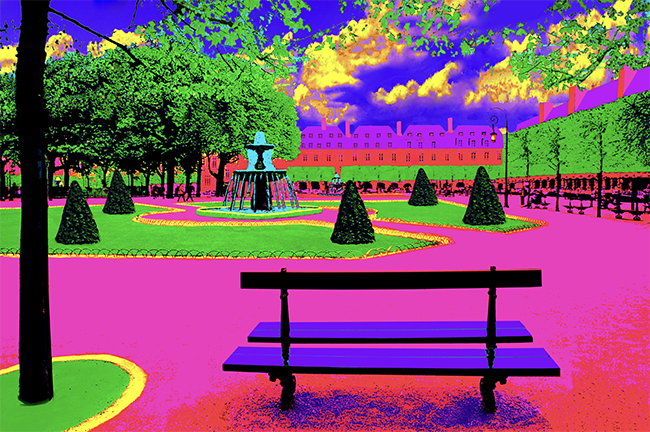
This approach is evident in Place de Vosges, 1977, printed 2017, an archival dye sublimation print on aluminum. The artwork depicts a garden square with a bench in the foreground, a fountain beyond it, and buildings enclosing the background. Its orderly arrangement supports an exuberant palette. Pink pathways, green lawns, purple seating, and a violet sky turn the setting into a place that feels familiar yet visually unexpected.
The empty bench gives the composition an immediate human connection. Positioned slightly to the right of center, its horizontal form stretches across the lower portion of the picture. Purple slats contrast with the dark frame and surrounding pink ground. The seat suggests a place to pause, inviting viewers to imagine themselves within the scene. Its stillness balances the active textures of foliage and clouds.
A dark tree trunk along the left edge establishes another structural element. Rising vertically, it counterbalances the bench and frames the garden. Branches extend overhead, while green leaves form a textured canopy. Dark marks scattered through the foliage preserve the impression of individual leaves and shaded spaces. These details bring variety to the surface, distinguishing the trees from the broad areas of saturated color below.
Farther into the square, the turquoise fountain becomes a second point of attention. Its shape stands out against the lawn and warm architectural colors. Curved planting borders guide the eye around it, while cone-shaped shrubs introduce repeated forms across the garden. Differences in size and position establish depth. The garden’s careful organization remains visible, giving viewers a clear route through the transformed setting.
The buildings provide a steady backdrop. Rows of windows and repeated roof shapes establish a rhythm that complements the planted forms below. Pink, orange, and red connect the architecture with the pathways, carrying warm color through the composition. Along the right side, trees reinforce the square’s enclosed character. These relationships preserve spatial clarity even when the colors depart from ordinary expectations.
Above the garden, yellow and orange clouds move across a deep violet sky. Their irregular shapes introduce energy beyond the measured arrangement of paths, shrubs, and buildings. Branches overlap the clouds, connecting the upper and lower portions of the image. Yellow accents along the garden borders echo the sky’s warmer passages, encouraging the eye to move throughout the picture.
The dates attached to the artwork place forty years between the original photograph and the printed version. That interval offers a way to consider Gottlieb’s continuing relationship with her photographic material. An image recorded during an earlier encounter becomes the basis for another visual experience, shaped by later choices and possibilities. The setting retains its identity while reflecting a different moment in the artist’s creative process. Each return to the image offers another opportunity to reconsider its mood and possibilities.
In Place de Vosges, color makes each element newly engaging. The bench invites a pause, the fountain draws the eye inward, and the sky expands the scene’s emotional atmosphere. Together, these elements express Gottlieb’s interest in making looking a joyful experience. Her transformation encourages viewers to notice the square’s design, imagine entering its spaces, and discover how color can renew their perception of a familiar place. The photograph becomes both a record of somewhere visited and an invitation to see that place through imagination. Its appeal rests in this meeting of structure and freedom, where the garden’s recognizable forms support an expressive world of color.


