
Born in 1987 in Karera, Madhya Pradesh, Rounak Rai develops a painting practice that connects Indian cultural narratives with questions of social responsibility. Educated at Navodaya Vidyalaya, he earned his MFA in Painting from the College of Fine Arts, Gwalior, before continuing his artistic development under Yusuf’s mentorship at Bharat Bhavan, Bhopal. His exhibition history includes eleven solo presentations and more than fifty group exhibitions in India and internationally.
Rai’s early figurative paintings explored stories from the Ramayana, Mahabharata, and several Puranas. Within these narratives, Kali and Durga became recurring subjects, expressing his interest in women as agents of leadership and change. His concerns also extend to environmental protection, women’s empowerment, and religious awareness. Across these subjects, inherited imagery becomes a means of examining contemporary life. His Ambedkar series continues this approach, bringing the struggle against caste oppression into a visual language shaped by storytelling, symbolism, and direct social engagement.
Ambedkar: Knowledge Against Injustice — III
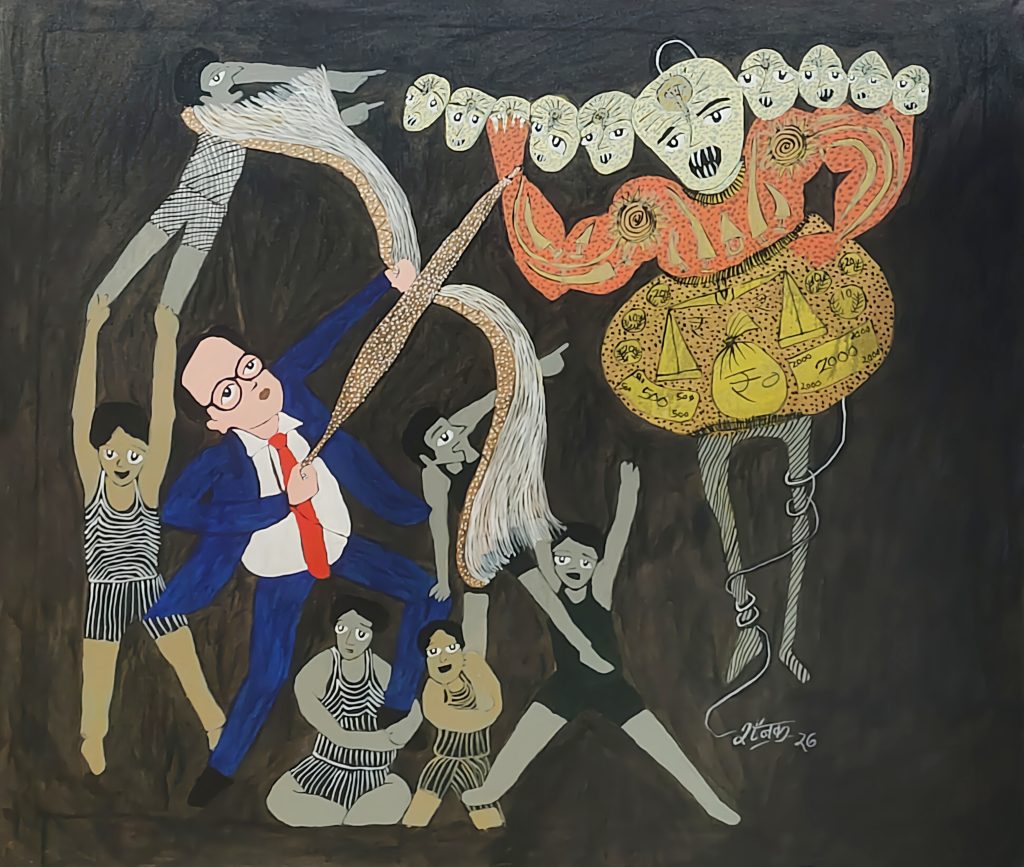
In Ambedkar: Knowledge Against Injustice — III, Rai constructs a confrontation between intellectual resistance and entrenched authority. The third painting in a six-part acrylic series, this 2.5 × 3 ft canvas places Dr. B. R. Ambedkar within an imagined struggle where cultural symbols acquire new social meanings. Knowledge becomes an active force, capable of challenging structures that deny people dignity and equality.
The composition establishes its tension through opposing bodies. On the left, Ambedkar appears in a blue suit, white shirt, and red tie, his recognizable glasses anchoring his identity within the stylized scene. His legs extend across the lower canvas while his arms participate in a sweeping upward action. This is an image of movement and intervention: thought has entered the physical space of conflict.
Opposite him stands a large, many-headed being. Its orange upper body, pale faces, exposed teeth, and elongated legs give it an unsettling presence. The repeated heads suggest that oppression operates through multiple voices and expressions. Read within the artist’s stated theme, the creature can represent a hierarchy that survives through repetition, reproducing its assumptions across different institutions, relationships, and everyday encounters.
Rai complicates this image through the yellow form surrounding the creature’s middle. Currency denominations, a money bag marked with a rupee symbol, and a balance scale share the same enclosed space. Their proximity invites questions about the relationship between wealth and justice. The scale, ordinarily associated with fairness, appears embedded within a body covered in financial signs. Equality seems entangled with systems of possession and advantage.
Across the center, curved, patterned forms connect the opposing sides, their white, hairlike strands creating an energetic visual current. These arcs carry the eye upward and outward, making the confrontation feel unstable. Rather than organizing the scene into separate compartments, Rai allows its lines to overlap and cross. The struggle occupies shared space, suggesting that resistance must engage directly with the structures it seeks to change.
Several smaller people gather around Ambedkar. Some raise their arms; others sit close together near his feet. Their varied postures introduce a collective dimension to the scene. They are witnesses, participants, and possible beneficiaries of the struggle. Their presence shifts attention from an individual act of courage toward the wider human stakes of liberation, including the need for solidarity and protection.
The dark background intensifies these relationships. Blue, orange, yellow, and pale gray emerge clearly against its uneven surface, while fine stripes and dotted patterns animate clothing and bodies. Rai’s simplified anatomy supports the narrative: gestures remain readable, expressions feel immediate, and differences in scale establish unequal concentrations of authority. The painting communicates through deliberate exaggeration rather than anatomical realism.
According to Rai’s description, books and the pen become instruments of intellectual resistance throughout this work’s conceptual framework. That premise guides the reading of the confrontation. Education is presented as a means of recognizing injustice, questioning inherited rules, and articulating an alternative. Knowledge carries responsibility because its value extends beyond personal advancement to the conditions under which others live.
The painting’s mythic structure also connects with Rai’s earlier interest in Indian religious narratives. Here, familiar conventions of confrontation are redirected toward a struggle over caste, dignity, and social power. Ambedkar occupies the active center of that transformation, while the surrounding people make its purpose visible. Through this charged encounter, Rai asks viewers to consider liberation as sustained work: learning, challenging exclusion, and insisting that equality become part of ordinary life. The canvas holds these demands together within a scene whose urgency comes from the unresolved relationship between authority and those who resist it.


