
Born in Montreal in 1964, Adamo Macri works across sculpture, photography, painting, video, and drawing. Objects provide the starting point for much of his practice. He constructs forms, considers how they meet the body, and uses framing and light to give those forms a life within an image. A photograph may be the final work, but it carries the presence of what Macri has built by hand. His approach allows a sculpture to become part of a portrait and a portrait to suggest an event beyond the frame.
Macri returns often to identity and transformation. In his staged images, a face may be partly concealed or altered, while the figure remains recognizably human. These changes invite viewers to look closely at how appearance shapes their sense of a person. Across mediums, Macri treats the physical form as something open to revision, capable of expressing experiences that are difficult to name.
Intermezzo (2024)
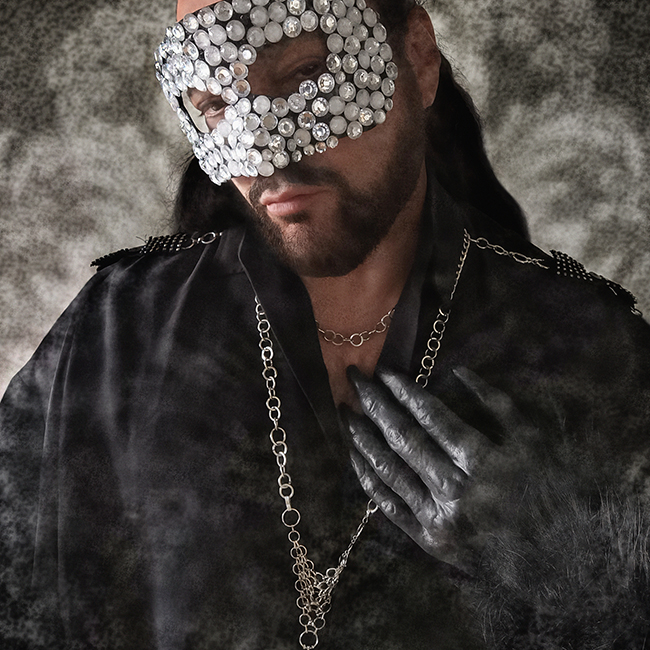
An intermezzo occupies the space between larger parts of a composition. It may offer a pause, but it also prepares us for what comes next. Macri gives that interval a human form in Intermezzo. A solitary figure appears within a carefully staged scene, with an elaborate construction surrounding the head. The image holds the figure at a moment that feels temporary yet intense, as though a change has begun but has not reached its conclusion.
The headpiece draws attention first. Its shape suggests several things at once: a mask, an ornament, and a form growing from the body. Its intricate surface makes it hard to tell where the person ends and the constructed element begins. That uncertainty gives the portrait its tension. We can see a figure before us, yet the usual clues by which we read a face have been changed. The work asks us to spend time with that altered presence rather than settle quickly on an identity.
Macri’s use of sculpture matters here. The construction has weight and texture; it occupies space around the figure instead of appearing as a fleeting visual effect. Its physical presence makes the transformation feel deliberate. Someone had to imagine the form, build it, place it, and account for how it would look under the light. The resulting photograph holds all of those decisions in a single moment.
The staging also gives Intermezzo a theatrical quality. The figure could be waiting to enter a scene or resting after one has ended. Costume, pose, and shadow suggest a performance, though Macri leaves its story unwritten. We do not know what happened before this image or what the figure will do next. That absence allows the pause to become the subject. The viewer encounters a moment that would ordinarily pass unnoticed between more decisive actions.
At the same time, the work feels inward. The construction around the head can be read as a visible form for thoughts or feelings that have yet to settle. It appears to change the figure as much as it conceals them. A conventional mask might allow someone to assume a familiar role; this one offers no role we can readily identify. It leaves the person suspended between possible versions of themselves.
Light strengthens that sense of suspension. Illuminated details bring the figure close, while darker areas withhold information about the surrounding space. The image has the concentration of a film still: it suggests movement on either side of the captured moment without showing that movement directly. Our attention returns to what is present now—the figure, the constructed form, and the quiet pressure between them.
Macri has described building sculptural elements before photographing them, with facial position, accessories, and lighting contributing to the final composition. In Intermezzo, that method gives the image an unusual density. It is a photograph of a staged encounter, yet it also records the meeting of sculpture and body. Each medium adds something: the constructed object changes the figure, while photography fixes their brief relationship in time.
The title offers another way to understand the work. An intermezzo is often considered a connecting passage, valued for how it leads from one part to another. Macri slows that passage down. He asks what might be visible while a person is between roles, before an unfamiliar state has become familiar. The figure’s uncertainty is given room to exist without being explained away.
This makes Intermezzo a portrait of transition. Its drama comes from a body and an object sharing one image so closely that neither can be understood in isolation. Macri leaves the transformation open, allowing viewers to imagine different beginnings and endings. What stays with us is the interval itself: a moment when identity seems tangible, carefully made, and still capable of changing.


