
Sonja Kalb creates abstract paintings that explore the evolving relationships among colour, material, gesture and space. Born in Stuttgart and now based in Düsseldorf, Germany, she earned a Dipl. Ing. degree in Textile and Applied Design. Her design education developed a refined understanding of surface, pattern, composition and material, elements that continue to inform her artistic language. Kalb’s creative path began with photography, observations of nature, portraiture and figurative studies before progressing into collage and abstract painting. Leaving recognizable representation behind gave her the freedom to communicate through atmosphere, rhythm and physical sensation. Her work has been presented internationally in museums, galleries, art associations and art fairs throughout Germany, Italy, France, the United Kingdom, the United States, Japan and South Korea. This September, Kalb’s paintings will be exhibited with sculptures by Kurt Grimm in MEET THE ARTISTS: Sonja Kalb & Kurt Grimm. The exhibition opens Friday, September 18, from 6 to 8 p.m.
Nature as Memory, Energy and Sensation
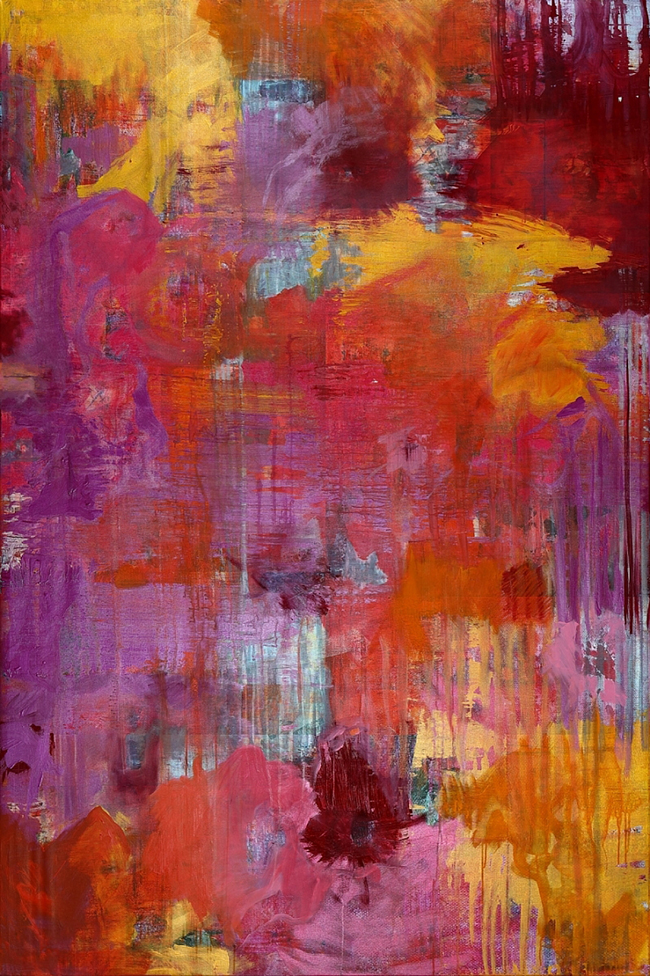
Rather than depicting nature literally, Kalb translates its energy into colour, movement and atmosphere. Her paintings do not present identifiable landscapes, flowers or forests. They communicate the sensations such environments can awaken: the warmth of sunlight, the motion of wind, the density of vegetation and the constant transformation of organic life.
A sweeping line may recall a plant bending in the air, while a glowing layer of pigment can suggest light filtering through foliage. Areas of concentrated colour may bring to mind fields, gardens or unfamiliar terrain. These references remain suggestive rather than descriptive, leaving viewers free to develop their own interpretations.
Kalb reduces her observations to essential visual relationships. Shape, colour, texture and rhythm become tools through which the experience of nature can be expressed without illustrating a specific place. In this way, the natural world is transformed from an external subject into an internal source of feeling and creative momentum.
Her compositions frequently exist between the recognizable and the unknown. A form may briefly resemble something familiar before merging into its surroundings. This uncertainty keeps the paintings visually active and encourages viewers to spend time with them. Meaning does not appear all at once but develops through observation, memory and individual association.
The sensation of movement is central to Kalb’s work. Expansive areas are placed beside concentrated passages, and soft transitions are interrupted by assertive marks. Some sections seem weightless and open, while others possess greater density and intensity. Together, these contrasts establish a rhythm that leads the eye across the painted surface.
Nothing feels completely settled. Forms rise through transparent layers, colours move into one another and marks appear to continue beyond the limits of the canvas. The compositions often seem caught in the middle of a transformation, as if they might change again at any moment.
This fluidity reflects the artist’s interest in processes that cannot be permanently fixed. Nature grows, disappears and returns in new forms. Light changes from one moment to the next, and familiar surroundings can appear entirely different depending on season, weather or time of day. Kalb captures this instability through compositions that remain visually open.
Building a Painting Through Layers
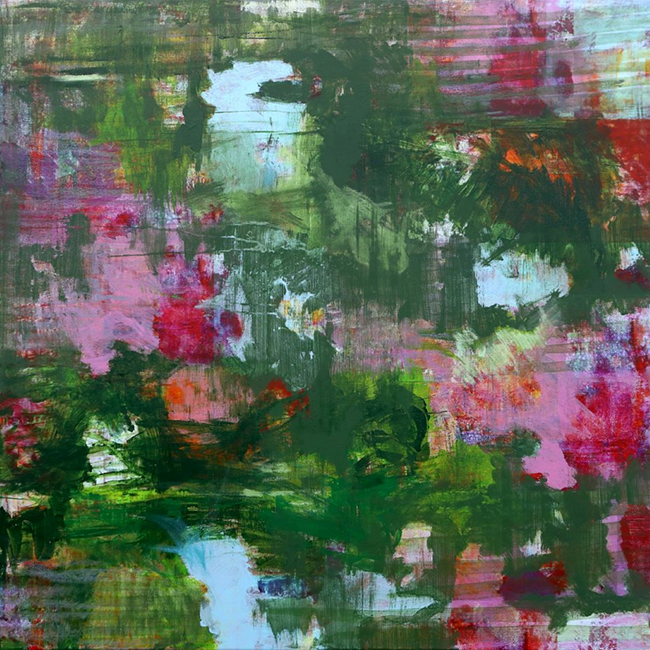
Kalb develops her surfaces through repeated stages of painting, adjusting and reconsidering. Pigment is added, covered, softened or removed as the composition evolves. A new layer may conceal part of an earlier image, while scraping and thinning can uncover colours or gestures that were previously hidden.
These visible traces give each painting a sense of accumulated time. A faint mark beneath the surface, an interrupted line or a partially covered area allows the viewer to glimpse the work’s earlier stages. The final image therefore contains a record of its own construction.
Her method is guided by close observation of what occurs during the painting process. Although she may begin with a direction or visual idea, the composition is not completely determined in advance. Each decision produces new possibilities. An unexpected mixture of colours may shift the painting’s emotional tone, while an accidental gesture may suggest a new structure.
Kalb responds by reorganizing the relationships among the elements. She may strengthen one passage, quiet another or remove something that has begun to dominate. The painting gradually finds its direction through this continuous exchange between the artist’s intentions and the material’s behavior.
Spontaneity is balanced by careful judgment. Kalb remains attentive to scale, proportion, tension and the distribution of visual weight. Strong marks are placed in conversation with quieter spaces, and highly detailed areas are balanced by moments of openness. The completed composition emerges from both intuitive action and thoughtful revision.
Her background in Textile and Applied Design is evident in this sensitivity to the organization of a surface. Textile design requires an awareness of pattern, repetition, texture and the ways colours influence one another. Kalb brings this knowledge into her paintings without allowing it to become restrictive.
Order is continually challenged by variation. Repeated shapes change in scale, patterns dissolve and carefully organized passages are interrupted by expressive gestures. These disruptions introduce surprise and prevent the composition from becoming overly controlled. Stability and uncertainty remain present at the same time.
Colour as an Independent Force
Colour carries much of the emotional and spatial power of Kalb’s paintings. It is not used merely to identify an object or decorate the canvas. Instead, colour functions as an active element capable of establishing atmosphere, movement and depth.
Bright or saturated hues may seem to move forward, while darker, softened or translucent areas appear to recede. A sudden contrast can introduce tension, and a gradual transition between related tones can create calm. Through these relationships, Kalb builds spaces that feel expansive even when no conventional perspective is present.
The emotional effect of a painting does not depend upon a single colour but upon the way multiple colours interact. Warm and cool areas may pull in different directions, while subtle variations within one colour family can produce a sense of harmony. Elsewhere, unexpected combinations create friction and intensity.
Kalb leaves these emotional qualities open to interpretation. She does not instruct the viewer to experience a composition in a particular way. The same arrangement may appear joyful and energetic to one person but mysterious or unsettled to another. Such differences are not contradictions. They demonstrate the capacity of abstraction to connect with individual memory and perception.
The works often reveal themselves gradually. Large gestures and vivid areas of colour may define the initial encounter, but prolonged viewing brings less obvious details into focus. Fine textures, softened boundaries and fragments concealed beneath the upper layers begin to emerge. Each discovery changes the viewer’s understanding of the whole.
Returning to Ideas Through Series
Kalb frequently works in series, enabling her to examine a subject through several related compositions. One idea may be explored through different dimensions, palettes, materials and forms of movement. Each painting stands independently while contributing to a broader investigation.
This approach allows an artistic question to remain open. Instead of forcing a single work to provide a final conclusion, Kalb permits the idea to expand across multiple canvases. One composition may emphasize light and transparency, while another approaches the same theme through heavier textures or more forceful contrasts.
Subjects from earlier periods sometimes return after several years. When Kalb revisits them, she does so from a changed personal and artistic position. The new paintings do not repeat the earlier works. They extend the conversation, revealing how the artist’s understanding has developed over time.
This recurring process reflects the cycles of the natural world. Seasons repeat, but no season is identical to the one before it. Plants grow again in altered conditions, and landscapes are continuously reshaped by weather, time and human presence. Kalb’s series follow a comparable pattern of return, renewal and transformation.
The Physical Presence of the Surface
Materiality is inseparable from the meaning of Kalb’s work. Brushstrokes, layered pigments, scraped areas and textured passages retain evidence of the physical actions that formed them. Direction, speed and pressure remain visible, giving the surface a strong bodily presence.
Encountering the paintings in person creates a changing visual experience. From a distance, the viewer may first notice the overall arrangement of colour, movement and scale. At closer range, smaller details become visible: irregular edges, subtle tonal shifts, underlying marks and the points where different materials meet.
As the viewing position changes, so does the painting. Certain textures become more prominent under the light, while transparent passages reveal depths that may not be immediately visible. The work encourages movement and sustained attention instead of offering a single fixed viewpoint.
Kalb’s paintings ultimately create spaces for personal reflection. They bring together qualities that might initially seem opposed: spontaneity and control, intensity and calm, structure and freedom, density and openness. These contrasts remain in active balance throughout her compositions.
Instead of copying nature’s visible appearance, Kalb expresses its underlying vitality. Through colour, gesture, texture and layered material, she evokes the continuous processes of growth, change, disappearance and renewal. Her paintings remind us that nature is never truly still and that perception itself is always shifting.
Sonja Kalb’s Upcoming September Exhibition
MEET THE ARTISTS: Sonja Kalb & Kurt Grimm
Opening: Friday, September 18, from 6 to 8 p.m.
Meet the Artists: Both artists will be present for an engaging evening of conversation.


