
Jane Gottlieb’s vibrant body of work emerges from a lifelong interest in color, motion, and visual intensity. Raised in Los Angeles and now living in Santa Barbara, she began her artistic journey as a painter before discovering photography as another vehicle for creative exploration. More than three decades ago, she started hand-painting individual Cibachrome prints, developing an approach that would become fundamental to her artistic identity. For Gottlieb, a photograph is not a finished document but the beginning of a transformative process. By reworking its colors and surfaces, she turns recognizable buildings, city streets, and landmarks into expressive new realities. Her images combine the structural precision of photography with the freedom and tactile character of painting. The resulting scenes appear both recognizable and invented, revealing how imagination can reshape the way we see and remember the world.
Between the Photographed City and the Imagined One
In Gottlieb’s art, color carries the emotional weight of each composition. It does more than enhance the appearance of a location; it changes its identity. Real places become intensified through luminous reds, electric blues, radiant yellows, and deep violets. These colors shift the atmosphere of the original photograph, creating scenes that may feel celebratory, cinematic, surreal, or contemplative.
Photography gives Gottlieb a foundation of architecture, perspective, and recognizable detail. Her painterly treatment then moves the image away from straightforward documentation. The finished work exists between two visual traditions: one connected to the observed world and another guided by emotion and invention.
In Paris Pyramid at Dusk, the Louvre Pyramid dominates the image with its unmistakable triangular form. Positioned at the center, the structure gives the composition a strong sense of symmetry and stability. Its glass framework is outlined in glowing violet, while brilliant shades of orange, pink, and yellow illuminate the pyramid and the surrounding sky. Beneath it, the reflecting pool becomes an expanse of saturated blue and purple scattered with fragments of light.
The composition’s diagonal lines pull the eye toward the pyramid’s highest point. This carefully controlled geometry establishes order, but Gottlieb’s energetic palette transforms the mood completely. The sky seems charged with both the warmth of sunset and the brightness of neon. Meanwhile, the water below provides a cooler counterbalance, producing a dramatic contrast between firelike color and aquatic depth.
Rather than presenting the Louvre as a familiar tourist destination, Gottlieb turns it into an almost otherworldly structure. The scene no longer belongs to one precise moment. It may suggest a memory of Paris, an imagined evening, or a city viewed through the lens of the future. The landmark remains identifiable, yet its atmosphere has been thoroughly reinvented.
Window Ladies uses the language of architecture in a more intimate and psychological way. Instead of presenting a monumental building, Gottlieb focuses on a row of windows containing several women’s faces. The window frames divide the composition into separate sections, giving it the rhythm of a storyboard or a sequence of film scenes.
The figures appear physically close but emotionally disconnected. One woman is shown in profile, another looks downward, and the enlarged faces nearby direct their gazes beyond the image. Their different poses imply that each is experiencing a separate moment, despite occupying the same architectural setting.
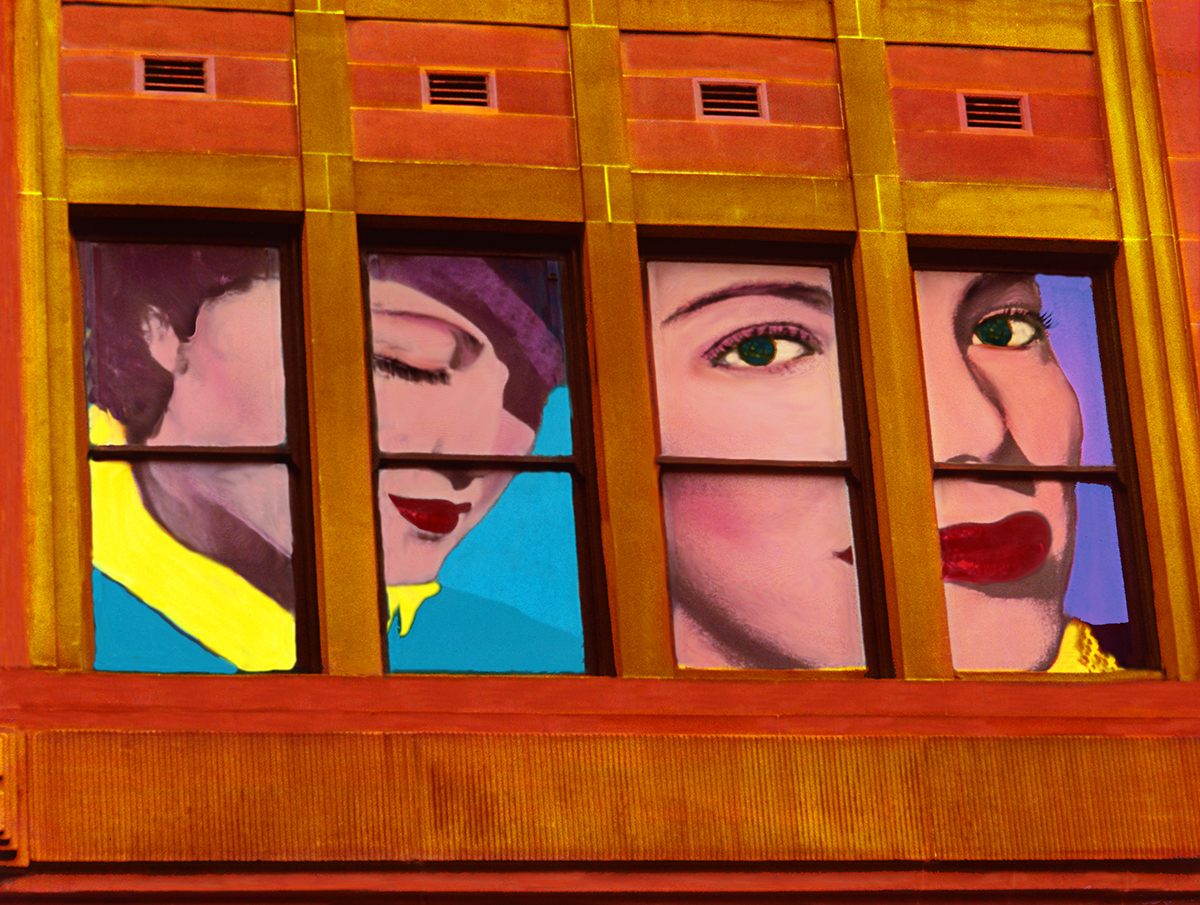
Turquoise, yellow, red, pink, and violet create a bold graphic quality reminiscent of fashion photography, classic advertisements, and cinema. Yet the beauty and glamour of the colors are complicated by the windowpanes crossing the women’s faces. The glass allows them to be seen while keeping them at a distance. They become both present and inaccessible, raising subtle questions about public appearance, privacy, and the act of looking.
There is also a strong narrative quality within the arrangement. The women appear to belong to a shared story, but Gottlieb does not reveal how they are connected. Their expressions offer clues without providing answers. Like a film still removed from its original sequence, the image invites viewers to invent the events surrounding it.
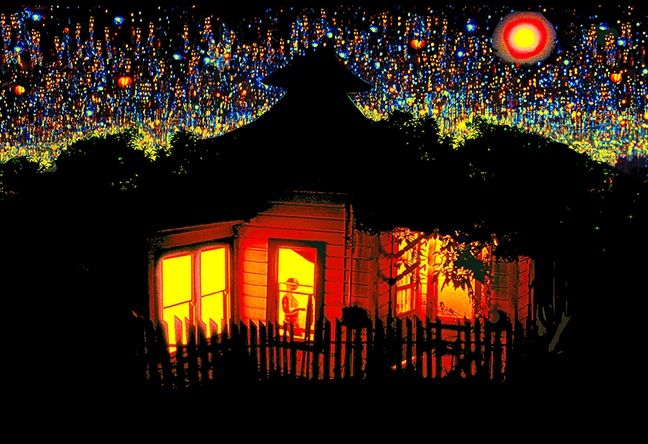
In China Town Full Moon Lady, Gottlieb shifts toward a more solitary and atmospheric form of storytelling. Much of the scene is covered in darkness, creating a dramatic contrast with the colored lights scattered throughout the image. A sharply defined roofline divides the glowing city above from the illuminated domestic space below.
In the distance, countless points of blue, red, orange, and yellow suggest an active urban landscape. Individually, they resemble windows and streetlights; together, they become a dense pattern approaching abstraction. The city feels alive, expansive, and restless.
Below this field of light, a single figure stands behind a glowing window. The brilliant yellow and red interior immediately draws attention, making the person the emotional center of the work. Although the house suggests warmth and protection, it also creates a sense of separation. The figure appears removed from the busy city, enclosed within a private and silent world.
Above, the full moon forms a second point of warm illumination. Its circular bands visually echo the windows and establish a connection between the human figure and the night sky. It may resemble a guiding light, a distant eye, or a silent observer suspended over the city.
Across these works, Gottlieb moves easily between monumental architecture, fragmented portraiture, and intimate urban drama. Structural elements such as glass panels, rooftops, windows, and reflections are essential to the meaning of each image. They direct the viewer’s gaze while creating feelings of order, distance, enclosure, or mystery.
Gottlieb’s practice expands photography beyond its traditional role as a record of visible reality. Although her images begin with actual subjects, their transformed palettes introduce emotion, fantasy, and personal interpretation. By merging photography with painting, she presents the world not simply as it looks, but as it might be remembered, imagined, or felt. Her work combines photography, painting, and Photoshop.


