
Born in 1950, Huang YI Min grew up during a period of profound social and cultural transformation in China, experiences that continue to shape both the emotional atmosphere and visual language of her art. A graduate of the Department of Fine Arts at Beijing Normal University, Huang developed her artistic foundation through close observation of everyday life, architecture, and the shifting rhythm of Beijing’s urban landscape. In 1997, she immigrated to the United States, carrying with her memories deeply rooted in China’s history and cultural identity. Her work reflects a dialogue between personal memory and collective experience, combining careful observation with emotional introspection. Through painting and drawing, Huang explores the relationship between place, memory, and inner reflection. The streets, buildings, and public spaces she painted in Beijing during the 1970s became more than documentary records; they became emotional anchors and the beginning of an imaginative journey that continues to unfold through her artistic practice today.
For Huang YI Min, painting is inseparable from life itself. Rather than approaching art as a profession alone, she describes painting as “the externalization of my soul,” a direct extension of her inner world. This deeply personal relationship with art can be felt throughout her body of work, particularly in the urban landscapes she created between 1972 and 1980. These paintings are not simply representations of Beijing during a specific historical period; they function as emotional records shaped by observation, memory, and lived experience.
During those years, Huang devoted herself to sketching from life, using the city around her as both subject matter and emotional mirror. Streets, public squares, libraries, and avenues became recurring motifs in her work. Through oil painting and drawing, she transformed ordinary locations into spaces filled with atmosphere and quiet reflection. Her paintings from this period reveal an artist paying close attention not only to physical structures, but also to the emotional resonance carried within them.
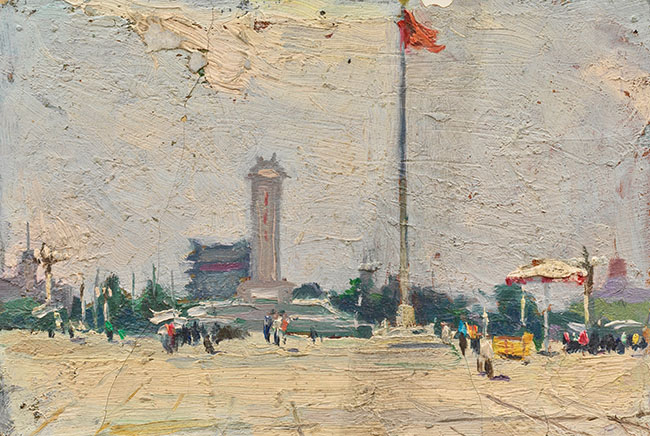
One example is Tiananmen Square in Beijing (1971), an oil painting on cardboard measuring 20 x 15 cm. While Tiananmen Square is widely recognized as a symbolic political and cultural center, Huang approaches the location through the lens of personal observation rather than monumentality. The modest scale of the work creates intimacy, encouraging viewers to experience the scene as a lived environment rather than a grand historical image. The use of oil on cardboard also reinforces the immediacy of the piece, suggesting spontaneity and direct engagement with the surrounding world.
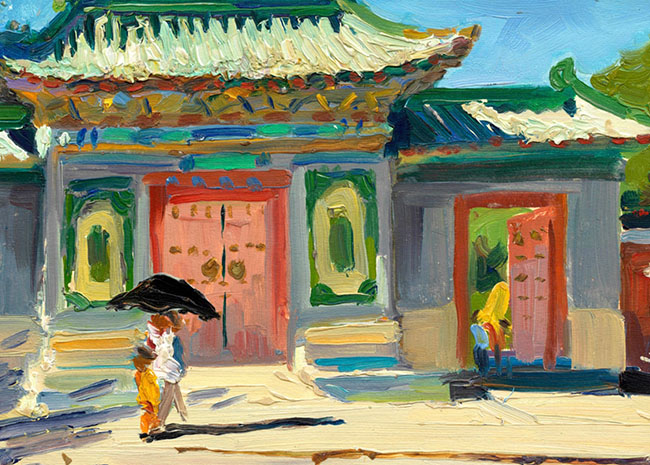
Similarly, Beijing Library (1972), painted in oil on cardboard at 20 x 30 cm, captures more than architecture alone. Libraries often symbolize memory, preservation, and knowledge, and Huang’s interpretation carries a quiet emotional weight. Her attention to atmosphere transforms the structure into a contemplative space. Rather than dramatizing the scene, she allows stillness and observation to guide the composition. This restraint gives the work a sense of honesty and closeness, qualities that continue to define her artistic voice.
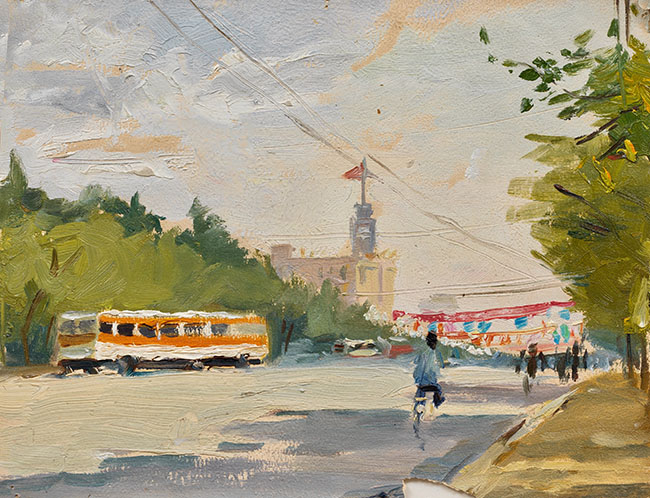
In Chang’an Avenue in Beijing (1973), Huang turns her attention to one of the city’s most recognizable thoroughfares. Measuring 30 x 20 cm and painted in oil on cardboard, the work reflects her ongoing interest in the interaction between movement and memory within urban spaces. Roads and avenues often represent transition, and in Huang’s work, the city itself becomes a living presence shaped by time and human experience. Her compositions avoid spectacle, instead focusing on atmosphere, structure, and emotional texture.
What makes Huang’s paintings particularly compelling is their balance between documentation and imagination. While grounded in direct observation, the works are not limited to realism alone. Huang explains that the Beijing urban landscapes she painted during the 1970s became “the starting point of my imagination.” This idea is central to understanding her practice. The cityscapes are not static records of the past; they are foundations for emotional and imaginative exploration. Memory reshapes the physical world, allowing familiar streets and buildings to carry psychological depth.
Her use of drawing and oil painting further supports this process. Sketching from life serves as a method of internal reflection, a way of understanding both the outside world and her own emotional response to it. The physical act of drawing becomes contemplative. Through line, texture, and composition, Huang translates observation into feeling. Even in works depicting public spaces, there is a quiet sense of intimacy present throughout.
After immigrating to the United States in 1997, Huang carried these experiences and visual memories with her. The distance from Beijing likely intensified the emotional significance of the works created during her earlier years. The paintings now function not only as reflections of a specific time and place, but also as connections to personal history and cultural identity.
At the center of Huang YI Min’s work is the idea that art preserves emotional experience. Her paintings remind viewers that cities are more than physical environments; they are containers of memory, imagination, and personal meaning. Through careful observation and emotional honesty, Huang transforms familiar urban scenes into reflections of the inner self, allowing painting to become both witness and companion to life itself.


