
Evgeniy Ananin is an artist whose work invites viewers to look beyond physical appearances and consider the inner forces that shape human identity, imagination, and achievement. Through expressive brushwork, heightened color, and symbolic imagery, he creates scenes that feel suspended between portraiture and psychological theater. Rather than relying on polished realism, Ananin allows the texture of the paint and the energy of the composition to communicate emotion. His figures emerge from layered, atmospheric surroundings, giving them the quality of memories, visions, or characters occupying an interior world. In Genius, created in 2019 in oil on canvas, Ananin examines the complicated idea of exceptional intelligence. The painting does not simply present a celebrated mind. It asks what genius looks like, where inspiration originates, and how intellect, imagination, desire, and uncertainty may coexist within one creative consciousness.
A Portrait of the Creative Mind
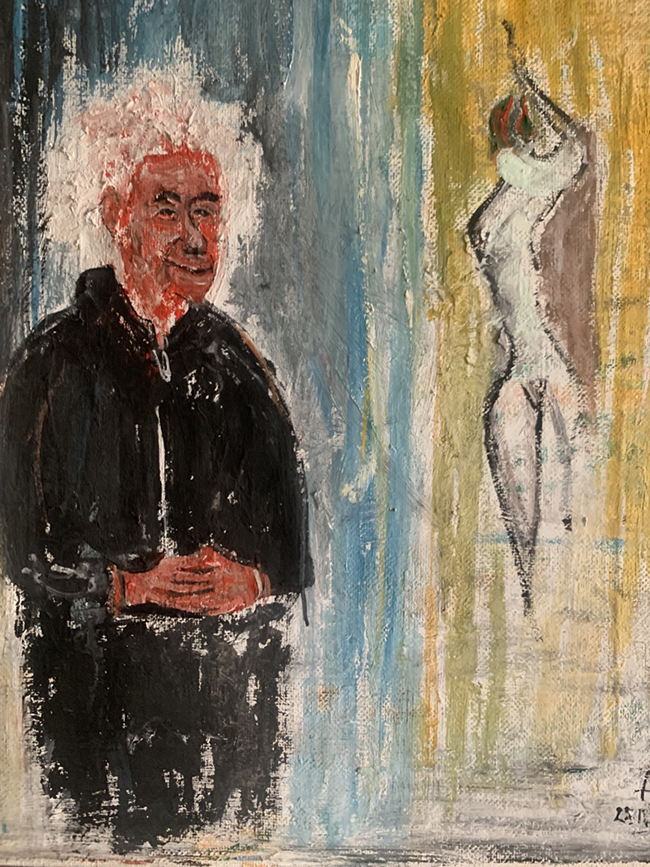
At the center of Genius is a seated man with untamed white hair, a vivid red face, and a dark garment. His appearance immediately evokes the familiar cultural image of a brilliant thinker, particularly through the contrast between his bright hair and intense expression. The painting does not identify him through precise academic portraiture. Instead, Ananin turns him into an archetype: a recognizable embodiment of intellect, curiosity, and unconventional thought.
The man sits with his hands gathered calmly in front of him. His posture appears composed, yet the surrounding brushwork is restless and energetic. This contrast creates an important tension. Outwardly, the figure seems still, perhaps even amused, but the space around him appears alive with movement. Vertical strokes of blue, white, green, and yellow pass across the canvas like streams of thought. They suggest that the visible stillness of the body may conceal an extraordinarily active interior life.
Ananin’s use of color gives the portrait much of its psychological force. The figure’s face and hands are rendered in saturated reds and oranges, making his physical presence feel heated and immediate. These tones may suggest intellectual intensity, creative energy, or the pressure that accompanies relentless thinking. His black clothing anchors the lower half of the composition and gives him a strong visual weight. Flecks of white paint interrupt the dark surface, connecting the figure to the raw, textured environment around him.
The pale blue area behind the man creates a cool counterpoint to his red skin. Blue can be associated with reflection, distance, and the unknown, while the warmer yellow section on the right introduces a contrasting sense of light and revelation. The painting therefore appears divided into different emotional or mental territories. The seated thinker occupies one space, while a mysterious standing figure inhabits another.
This second figure is one of the painting’s most intriguing elements. Drawn with a loose dark contour and pale, nearly transparent color, the figure resembles a nude woman, a mannequin, a sculpture, or an apparition. Her arms are raised, and a small red form appears close to her head. Unlike the seated man, she is not fully individualized. She belongs to the realm of symbol, imagination, or invention.
Her presence allows several interpretations. She may represent a muse, an artistic idea, beauty, desire, or the elusive moment when inspiration takes form. She may also embody the creative vision existing inside the thinker’s mind. The vertical band of blue between the two figures functions almost like a curtain, doorway, or psychological boundary. It separates material reality from imagination while still allowing the two spaces to communicate.
The title Genius adds another layer of ambiguity. Ananin does not present genius as a purely intellectual condition. The painting connects thought with sensuality, color, memory, humor, and fantasy. The man’s faint smile prevents the work from becoming overly solemn. He appears aware of something beyond the viewer’s understanding, as if he has already entered into a private conversation with the strange figure beside him.
The rough application of paint reinforces this sense of discovery. Brushstrokes remain visible, areas of canvas appear exposed, and forms seem to emerge without being completely resolved. This unfinished quality is essential to the work’s meaning. Creativity rarely arrives as a perfectly formed answer. It develops through fragments, experiments, impulses, and unexpected connections. Ananin’s technique allows the viewer to witness that process rather than only its conclusion.
The painting also resists the idea that genius must be represented through grandeur. Its scale of expression is intimate and human. The seated figure is not elevated on a pedestal or surrounded by symbols of authority. He wears simple dark clothing and occupies an uncertain, almost dreamlike setting. What distinguishes him is the invisible activity suggested by the composition: the interaction between observation and fantasy, discipline and freedom, reason and intuition.
Created in 2019, Genius ultimately offers a meditation on the mystery of original thought. Its power lies in what it leaves unresolved. Is the standing figure a memory, an artwork, a muse, or an idea waiting to be realized? Is the seated man observing her, imagining her, or remembering something that has disappeared? Ananin provides no fixed answer. Instead, he creates a visual space in which thought becomes color, inspiration becomes a figure, and genius emerges as an ongoing dialogue between the visible world and the private territories of the mind.


