
Born in 1949 and raised in California’s Bay Area, Deborah K. Tash is a painter and poet whose creative practice explores the relationship between cultural identity, spirituality, and the natural world. Her artistic perspective draws upon her multicultural background, with Mexican ancestry through her mother and Celtic heritage through her father. Identifying as Mestiza, Tash embraces the intersection of these traditions, allowing their stories, symbols, and spiritual associations to inform her work.
Painting and poetry provide complementary ways for Tash to investigate human experience. Her compositions frequently incorporate symbolic imagery, organic forms, and references to mythology, creating visual narratives that invite personal interpretation. Rather than presenting fixed meanings, she encourages viewers to consider the connections between memory, emotion, and imagination. Through her artistic language, Tash examines the mysteries of existence while celebrating the enduring relationship between humanity, ancestral traditions, and the living environment.
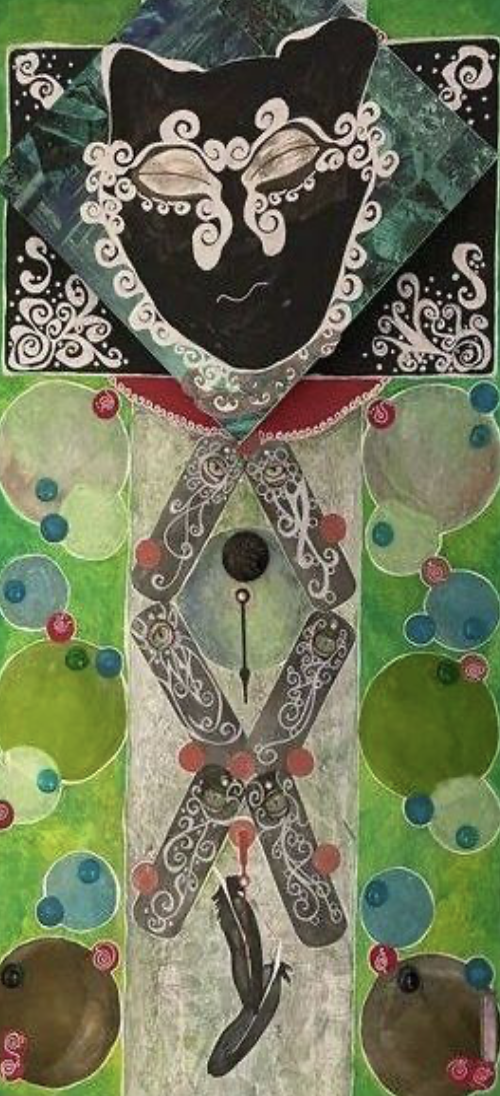
Totem Series/Sleeping Jaguar III: A Visual Exploration of Symbolism and Dreams
In Totem Series/Sleeping Jaguar III, Deborah K. Tash presents an imaginative composition in which animal imagery, decorative patterns, and geometric structures converge. The painting centers on the face of a sleeping jaguar, surrounded by an elaborate arrangement of swirling ornaments, overlapping shapes, and contrasting colors. Its unusual combination of recognizable imagery and abstract design creates an atmosphere that feels simultaneously playful, mysterious, and contemplative.
The jaguar occupies the upper portion of the composition, its dark face outlined by flowing white patterns. Closed eyes suggest a state of rest, while the carefully arranged facial features give the animal a peaceful, almost meditative expression. Rather than portraying the jaguar through realistic anatomical details, Tash transforms its appearance into a symbolic presence. The animal becomes a point of connection between the physical world and an imagined realm shaped by dreams, intuition, and memory.
The jaguar carries associations with strength, mystery, and spiritual transformation in various Indigenous American traditions. Within Tash’s painting, these associations offer possible interpretations without limiting the image to one cultural meaning. The sleeping animal may suggest an inward journey, where consciousness moves beyond ordinary perception and enters a space of reflection. Its stillness contrasts with the surrounding visual activity, establishing a relationship between calmness and movement.
One of the painting’s most engaging qualities is its intricate decorative vocabulary. White spirals travel across the jaguar’s face and extend into the surrounding black rectangular field. These curling forms resemble ornamental flourishes, natural growth patterns, and abstract representations of energy. Their repetition establishes a visual rhythm that guides the viewer around the animal’s head.
Behind the jaguar, overlapping green and blue-green geometric shapes introduce another dimension of complexity. The angular arrangement contrasts with the curved decorative elements, creating tension between structured design and organic movement. Collaged textures contribute to the painting’s layered appearance, suggesting that different visual fragments have been assembled into a unified imaginative environment.
Below the jaguar’s head, an elongated vertical form contains additional symbolic details. Decorative shapes resembling feathers, patterned limbs, and ornamental markings extend downward through the composition. Near its center, a dark circular shape connects to a thin vertical line, introducing an element that resembles a suspended object or ceremonial marker. These details encourage viewers to examine the painting gradually, discovering relationships between its individual components.
Color plays an equally important role in establishing the work’s atmosphere. Brilliant greens dominate the background, while turquoise, blue, red, cream, and deep brown appear throughout the composition. Circular forms of different sizes float along both sides of the central structure, creating an impression of movement through an otherwise carefully balanced arrangement.
Some circles appear translucent, while others contain darker centers or contrasting outlines. Their varying dimensions and overlapping placement produce a sense of depth and visual movement. They might evoke bubbles, celestial bodies, or fragments of remembered imagery. Their ambiguity contributes to the dreamlike character of the painting, allowing each viewer to develop personal associations.
The contrast between the jaguar’s dark face and the bright surrounding colors establishes a focal point. Meanwhile, the intricate patterns and cascading circular accents prevent the eye from remaining fixed in one location. The composition continually directs attention between its central animal image and the decorative environment that surrounds it.
Through Totem Series/Sleeping Jaguar III, Tash demonstrates how symbolism and abstraction can coexist within a single visual narrative. Her use of animal imagery, ornamental details, and layered textures creates an imaginative setting in which cultural references and personal expression intersect.
The painting ultimately invites contemplation rather than offering a definitive story. Its sleeping jaguar suggests hidden awareness, while the surrounding forms evoke an active world of dreams and associations. By bringing these elements together, Deborah K. Tash creates an artwork that encourages viewers to explore the connections between nature, identity, imagination, and the unseen dimensions of human experience.


