
For almost half a century, multidisciplinary artist Vandorn Hinnant has investigated intuition, ancestral understanding, consciousness, and dimensions beyond physical sight. His paintings and writings are closely connected to personal experiences that he interprets as contact with spiritual and non-physical realms. Instead of dismissing accounts of invisible beings as folklore, Hinnant places them within humanity’s long-standing desire to comprehend realities that exist outside ordinary sensory experience.
This perspective lies at the center of his artistic practice. Hinnant refers to some of his images as “spirit whisperings,” suggesting that they carry subtle messages from beyond the material world. Organic shapes, symbolic arrangements, layered color, and instinctive marks allow him to translate internal encounters into visual form. His art does not function solely as decoration. It becomes an instrument for examining consciousness and connecting visible existence with what remains unseen.
Tracing the Forms of Inner Experience
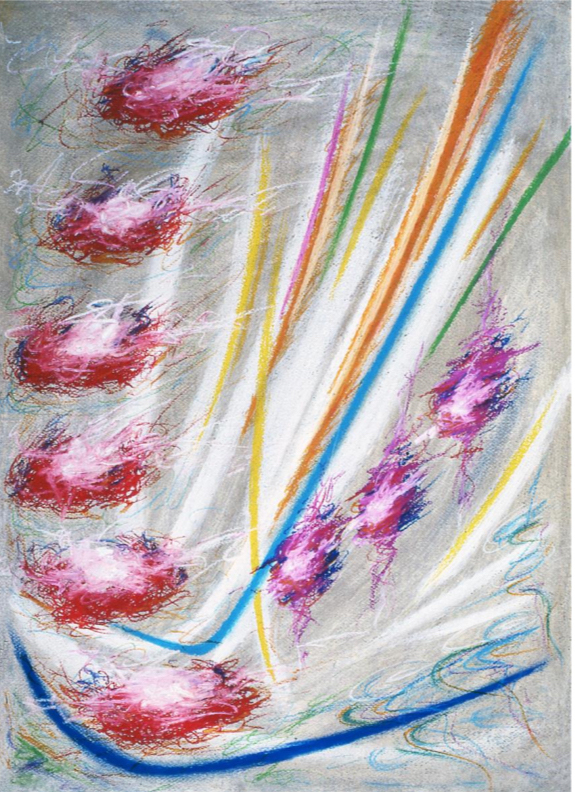
Flash of the Spirit reflects upon an earlier understanding of life in which the physical and spiritual worlds were not viewed as entirely separate. Before modern cultures began explaining life and death through predominantly scientific models, many ancestral communities accepted the presence of spirits, departed souls, and other forms of non-physical consciousness. Shamans, healers, and spiritual intermediaries were often entrusted with maintaining communication between these different realms.
This ancestral worldview provides a philosophical context for Hinnant’s work. However, his art is not intended to promote a particular religious belief or establish a definitive theory of the afterlife. It instead creates space for viewers to contemplate the possibility that human consciousness may reach beyond the body and the limits of observable reality.
Hinnant’s exploration of these ideas began during childhood. He started making intentional marks at approximately five years old. By the age of thirteen, his drawings had developed into visual records of images and impressions arising from within. What began as a youthful creative response gradually became a disciplined investigation that continued across five decades.
These early experiments eventually formed the foundation of the series Hinnant identifies as his “organic abstractions.” The works vary considerably in appearance. Certain compositions consist of flowing areas of color that appear to contain independent energies or presences. Others are built from intricate, structured forms that recall cells, microscopic organisms, or biological systems. The imagery can suggest natural growth, unfamiliar landscapes, or living matter, yet it is not based exclusively on observation of the external world.
Instead, Hinnant’s abstractions originate from inner visions, intuitive sensations, and experiences for which no conventional image exists. His creative process offers these intangible encounters a physical presence. Lines, colors, and shapes become elements of a personal visual language through which he can preserve what might otherwise remain inaccessible.
Although his mark-making often appears spontaneous, it is guided by a consistent philosophical intention. Hinnant is not attempting to produce literal portraits of spiritual beings. His images act more like energetic impressions, capturing the qualities or signatures of consciousness as he experiences them. They suggest rather than explain, allowing each viewer to approach the imagery through intuition as well as observation.
The writings of Carlos Castaneda later provided Hinnant with another way to interpret this body of work. Castaneda’s widely read accounts of shamanic teachings, reportedly connected to Yaqui traditions, included descriptions of entities he called “inorganic beings.” After encountering this concept, Hinnant recognized a possible relationship between Castaneda’s descriptions and the sentient forms he believed he had been recording throughout his life.
The significance of this discovery lies in its timing. Castaneda’s language did not inspire the original images, since Hinnant had already been producing them for years. Instead, it supplied a conceptual reference for creative experiences that had previously resisted definition. The artwork arrived first; an intellectual structure through which to interpret it emerged later. This sequence reveals the importance of intuition within Hinnant’s practice. Art allowed him to respond to an experience before his conscious mind could fully explain it.
A similar moment of recognition occurred when Hinnant encountered the art and biography of Hilma af Klint. Seeing the Guggenheim Museum exhibition Hilma af Klint: Paintings for the Future in 2018–2019 gave him a profound feeling of kinship. Af Klint’s spiritually inspired abstractions showed how an artist could produce an extensive and highly developed visual language before society was prepared to understand its purpose.
For Hinnant, learning about her life and work brought relief from a long-standing feeling of being misplaced within history. Her example helped him recognize that artists working through spiritual intuition may create their most important works before an appropriate cultural or intellectual framework exists. He described the experience as a form of homecoming that allowed him to accept his own journey more completely.
Hinnant’s organic abstractions now constitute an extensive archive created over much of his lifetime. Some preliminary sketches were transformed into finished artworks, while numerous black-and-white drawings remain as studies on paper. Organizing and presenting the complete series would be a considerable undertaking because of its size, range, and long period of development.
Among these works, Serendip and Analogue remain especially meaningful to the artist. Preserved in his private collection, they serve as personal reminders of his enduring involvement with the series and the many years devoted to exploring non-physical consciousness through art.
Hinnant continues to occupy the dual role of active artist and guardian of his creative history. Flash of the Spiritrepresents more than a single artistic idea. It belongs to a lifelong effort to document fleeting contact with realities that cannot be easily named or physically verified. His abstractions encourage viewers to move beyond familiar imagery and ask whether a work of art can preserve the imprint of memory, energy, or consciousness.
Within Hinnant’s practice, the invisible is neither a decorative theme nor an imagined escape from reality. It is an essential dimension of lived experience. Through his evolving language of organic abstraction, he gives that dimension shape, color, and a place within the visible world.


