
For Allan Wesaquate, painting is less about creating a fixed image and more about translating emotional energy into movement, color, and atmosphere. His abstract works carry a sense of motion that feels alive, almost unsettled, as if the surface itself is shifting in real time. Through swirling layers of acrylic paint, bright tones, and fluid compositions, Wesaquate creates paintings that reflect personal experience while remaining open enough for viewers to bring their own emotions into the work.
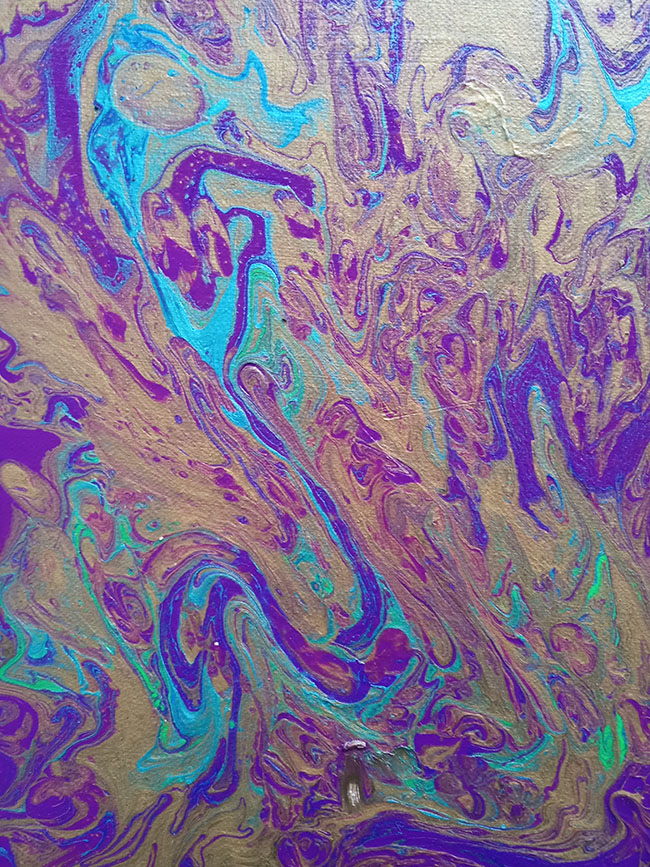
The painting shown here, created in 2024 with acrylic on linen, emerged during a difficult period in the artist’s life. Wesaquate explains that at the time he was dealing with repeated break-ins at his home. The experience left him feeling violated and emotionally exhausted, uncertain about when the disruption would finally end. Rather than depicting the situation literally, he transformed those emotions into abstraction. The result is a painting filled with tension, movement, and instability, yet also marked by vivid color and optimism.
That contrast sits at the center of Wesaquate’s artistic direction.
Although the painting was born from anxiety and uncertainty, it never collapses into darkness. Instead, waves of electric purple, turquoise, blue, and gold move across the linen surface in layered currents. The composition feels fluid and constantly changing, almost like liquid thought. Shapes dissolve into one another. Colors collide and separate again. There is no single focal point. Instead, the eye travels through the painting as if moving through emotion itself.
Wesaquate describes this visual language as “bubblegum psychedelic,” a term he began using in 2010. The phrase captures the unusual balance inside his work. On one side there is psychedelic influence: flowing forms, altered spatial perception, hypnotic movement, and emotional intensity. On the other side there is something lighter and more playful. The bright colors soften the emotional weight carried by the painting. Rather than trapping the viewer inside fear or anger, the work pushes toward resilience and emotional release.
This use of color is essential to the painting’s atmosphere. Wesaquate tends toward bright palettes because he wants to evoke optimism, even when the subject matter comes from personal hardship. The glowing turquoise lines cutting through the purple fields almost feel like moments of clarity emerging from confusion. Gold and beige passages create warmth beneath the more saturated tones, preventing the composition from becoming emotionally heavy. The painting holds conflict and hope at the same time.
What makes the work especially interesting is the way it avoids direct narrative. The viewer does not need to know about the break-ins to feel the emotional instability inside the piece. The painting communicates through rhythm and energy rather than storytelling. Some sections appear turbulent and compressed, while others open into softer flowing spaces. That push and pull creates a psychological tension that mirrors the emotional state Wesaquate experienced during its creation.
At the same time, the painting refuses stillness. Everything appears in motion. Lines bend, drift, spiral, and fold into one another. The composition feels organic, almost geological or cosmic, as if the surface records emotional weather patterns rather than physical objects. This gives the work a timeless quality. Even though it was made in response to a specific moment in 2024, the emotions embedded within it remain universal. Anxiety, vulnerability, endurance, and the desire for peace become visible through abstraction.
Wesaquate has noted that he reflects “the energy of the day, not a period of time.” That distinction says a great deal about his approach. His paintings are not attempts to recreate historical moments or external events in documentary form. Instead, they function as emotional records. The work captures the psychological atmosphere surrounding a lived experience rather than the literal details themselves.
That immediacy can be felt throughout this painting. There is no sense of over-control or rigid structure. The forms appear instinctive and responsive, allowing emotion to guide the movement of paint across the linen surface. Yet despite the spontaneity, the composition remains balanced. The brighter passages pull against darker currents in a way that keeps the eye engaged from edge to edge.
In many ways, the painting becomes an act of reclaiming emotional space. An experience that once created fear and instability is transformed into something visually energetic and strangely uplifting. Rather than allowing violation to define the outcome, Wesaquate redirects that energy into color, motion, and transformation.
The result is a painting that speaks through sensation rather than explanation. It invites viewers to enter its shifting emotional landscape and discover their own meanings within the flow of color and movement.


