
Julian Jamaal Jones grew up in Indianapolis, Indiana, long before he began to see himself as a multidisciplinary artist and educator. His relationship with art didn’t arrive through a single defining moment. Instead, it developed through many small encounters with culture, family, and the visual language that surrounded him. Jones eventually found his way into a practice that moves between photography, textiles, performance, and research. What ties these areas together is a steady interest in how stories are carried, protected, and rebuilt across generations. For Jones, creating isn’t only about adding something new to the world. It’s also about listening to what already exists, especially the traditions rooted in African American life.
Jones was born in 1992, and like many artists of his generation, he works at the intersection of personal identity and broader cultural memory. But his approach stands out because of how grounded it is. He doesn’t chase spectacle or polish the edges for the sake of trend. Instead, he leans into the textures and histories that shaped him from the beginning. Growing up in Indianapolis meant being surrounded by family traditions, church life, and the artifacts of everyday living. Quilts, clothing, craft objects—these weren’t abstract symbols but parts of real rooms, real people, and real stories. They held meaning long before he translated them into art.
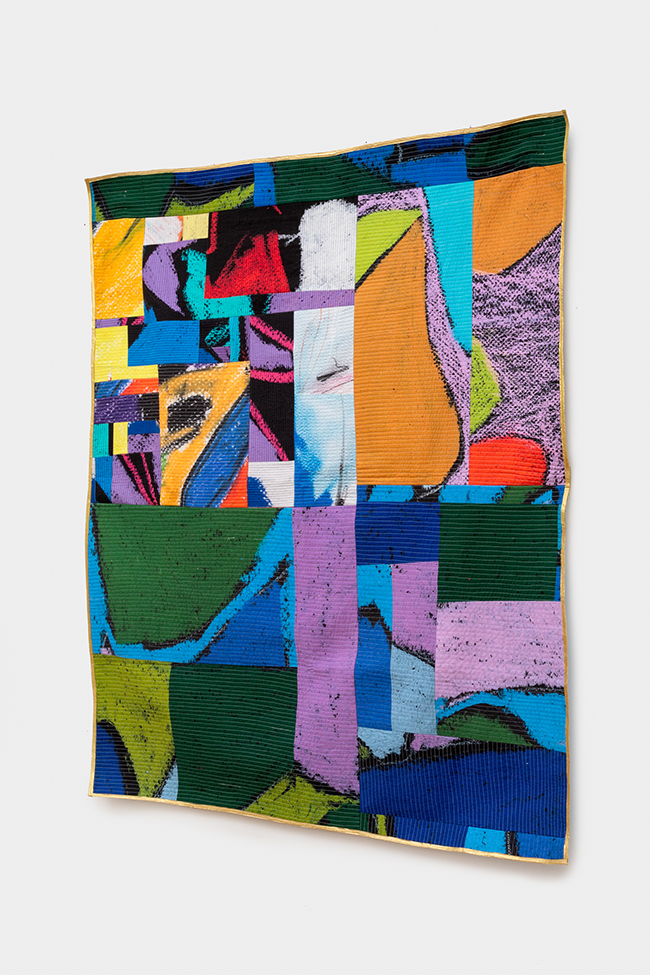
Much of Jones’s current work focuses on African American quilting, a form with deep roots, both functional and expressive. Quilts have long been carriers of emotion, community, protection, and coded messages. He doesn’t try to replicate older quilting styles, nor does he attempt to modernize them through flash or novelty. Instead, he borrows the underlying language and uses it to form something that feels both familiar and unexpected. His works often play with bold color, rhythmic geometries, and abstract compositions. These choices allow him to honor the tradition without being bound by it.
Jones also understands that heritage is not fixed. It shifts as people shift, as families grow or separate, as generations reinterpret what came before them. This is where his sense of creative freedom becomes clear. Even when he works within traditional frameworks, he bends, stretches, and complicates them. He brings abstraction into conversation with history, allowing the two to coexist without forcing either into a narrow definition. Viewers may come expecting nostalgia, but Jones doesn’t give them a one-way entry into the past. Instead, he opens space for dialogue: where memory meets invention, where craft meets contemporary exploration.
A recurring thread in Jones’s work is the desire to memorialize Black culture without making it feel static. His art isn’t a monument meant to freeze time. It is a living record, influenced by the world he moves through every day. He works from lived experience—childhood memories, texture, color, music, and the shared language of community. In his hands, quilts become more than textiles. They become maps of identity, evidence of survival, and invitations to reconsider what counts as art and what counts as history.
When Jones builds a composition, he treats color as a form of storytelling. Vibrant reds, deep blues, sharp yellows, and layered neutrals create surfaces that feel both grounded and open. The viewer can sense movement even in stillness. There is an emotional rhythm at play—sometimes celebratory, sometimes reflective. The structure of quilting gives him a clear foundation, but abstraction allows him to push past expectations. The result is work that feels anchored yet full of possibility.
Jones’s commitment to reframing tradition is also tied to his role as an educator. Teaching, for him, is not separate from creating. It is another way to share knowledge and challenge people to rethink what they believe about art, craft, and cultural expression. He is mindful of how much representation matters, especially for young artists who may not see themselves reflected in mainstream narratives. By bringing quilting into contemporary spaces, he shows that history has many doors, many ways to be entered, and many ways to be honored.
In recent years, Jones’s art has gained attention for its clarity of purpose and its refusal to fall into predictable language. His pieces don’t ask for permission to belong in the larger conversation around American art—they simply take their place. At the same time, the work never distances itself from the personal. It maintains a warm, grounded sense of origin. His use of quilting is not a conceptual gesture; it is a connection to real people, real lineage, and real stories.
Jones continues to expand his practice, and each new project builds on a steady foundation. He remains loyal to a craft that has shaped countless generations while letting his own experience guide the direction forward. In doing so, he keeps the tradition alive—not as something to preserve behind glass, but as something to use, reshape, and pass on. His work reminds us that culture grows through care, curiosity, and the courage to see familiar forms in fresh ways.


