
Sarah J Lloyd’s work lives in the space where things are almost recognizable, then quietly slip away. It is not about choosing between figuration or abstraction, but about letting both exist at the same time. Her paintings, drawings, and photocollages unfold as visual conversations—between color and form, between seeing and interpreting, between what we think we know and what we sense before language catches up.
At the core of Lloyd’s practice is an interest in how meaning forms. She draws a parallel between visual experience and language, noting that they often emerge together but are never identical. A shape can feel familiar without becoming an object. A color can carry emotion without telling a story outright. This tension—between recognition and ambiguity—keeps the work open, flexible, and alive.
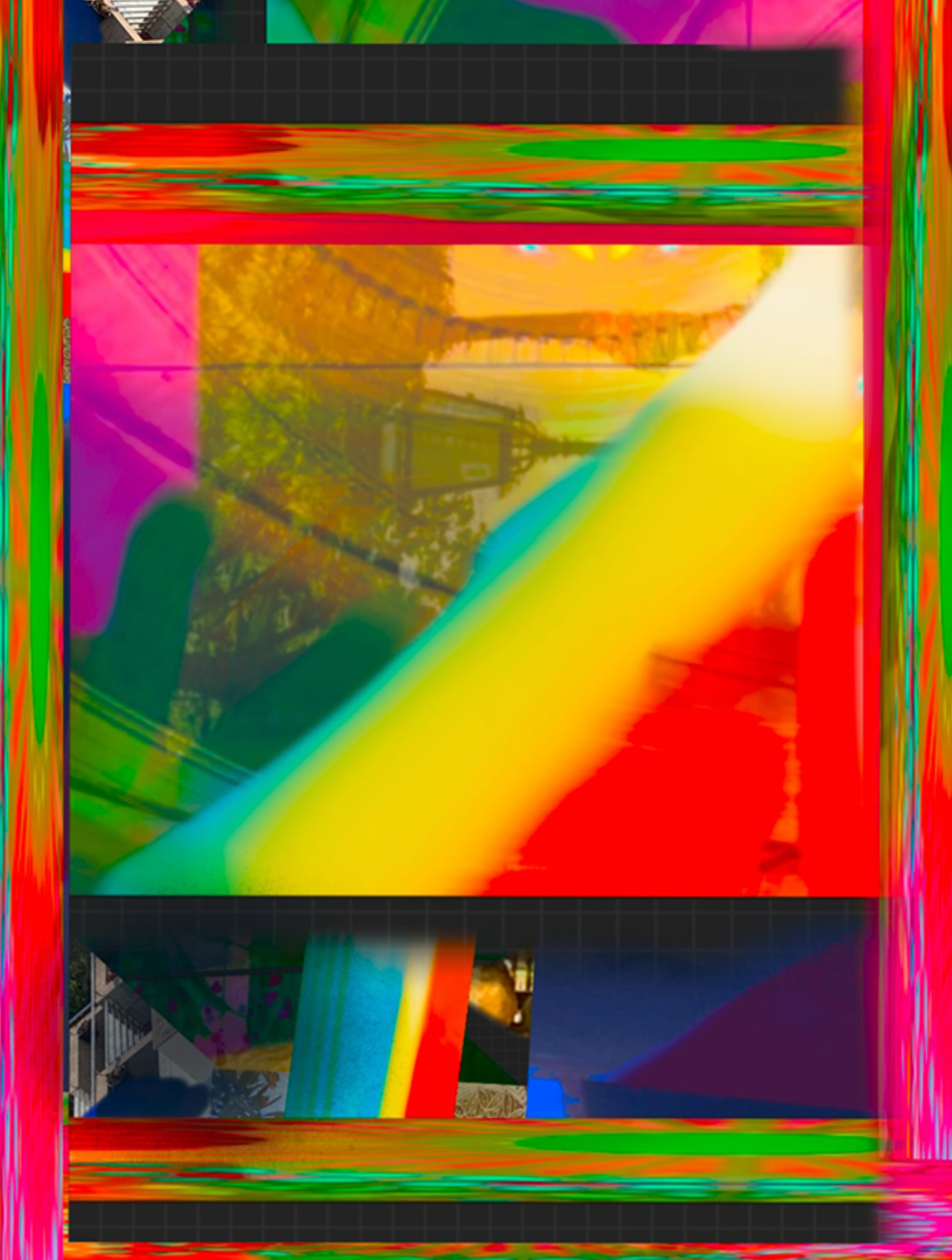
Color plays a central role in Lloyd’s work, not as decoration but as a kind of abstract language. Her use of color suggests rhythm and tone, closer to poetry or music than description. Layers of saturated reds, greens, yellows, and blues interact in ways that feel intentional yet fluid. These colors do not sit quietly. They move, press against each other, dissolve, and reappear. The effect is immersive, drawing the viewer into a field where color speaks on its own terms.
Rather than treating color as something that fills space, Lloyd treats it as something that structures space. Subtle shifts in hue or transparency change how a surface is read. A soft gradient might suggest depth, while a sharp contrast can flatten the image again. These small adjustments of scale and focus create crossovers—moments where abstraction hints at figuration, or where a fragment of the visible world briefly surfaces before slipping back into color and form.
Drawing and photocollage are essential tools in Lloyd’s process. They function as ways of tuning her looking, sharpening attention rather than resolving images. Photocollage allows her to fragment and reassemble visual information, breaking down familiar scenes into parts that can be re-seen. Drawing slows the act of looking even further, encouraging a careful engagement with line, edge, and proportion. Together, these practices inform her paintings, not as preparatory steps, but as parallel ways of thinking.
The finished works often feel layered not just materially, but perceptually. One can sense multiple viewpoints folded into a single image. There is a feeling of movement across the surface, as though the work is holding several moments at once. This quality resists quick consumption. The longer one spends with a piece, the more it shifts—details emerge, relationships change, and new associations form.
Lloyd’s work does not insist on interpretation. Instead, it invites participation. Viewers are encouraged to notice how they are looking, how quickly they try to name what they see, and what happens when that impulse is paused. In this way, the work becomes less about what is depicted and more about the act of perception itself. It asks: how do we construct meaning from color, shape, and fragment? What happens when meaning remains provisional?
There is also a quiet physicality to Lloyd’s surfaces. Even when working digitally or through photocollage, the results retain a tactile presence. Edges blur or assert themselves. Layers feel built rather than applied. This physical awareness grounds the work, preventing it from drifting into pure visual effect. The paintings feel considered, but not over-controlled, allowing space for intuition to play its role.
The attached artwork exemplifies these ideas. Vivid bands of color intersect with translucent layers, creating a sense of depth that is never fixed. Hints of photographic imagery hover beneath painterly gestures, partially obscured, partially revealed. The composition feels both contained and expansive, as if the image could extend beyond its borders. It is a work that rewards slow looking, offering different readings depending on where attention settles.
Ultimately, Sarah J Lloyd’s practice is about learning how to see again. By working between figuration and abstraction, she opens a space where perception can remain uncertain and responsive. Her use of color as an expressive language, combined with drawing and collage as tools of attention, results in work that feels thoughtful without being didactic. It does not provide answers. Instead, it creates conditions for reflection, allowing meaning to surface gradually, in its own time.


