
Attila Wittmer builds a world where the human head becomes far more than an anatomical form. In her art, the head is a landscape, a vessel, a pressure chamber of emotion and memory. She treats it as a surface where internal states spill outward—where desire, pain, contradiction, and the quiet weight of being alive collide. Her drawings arrive from a place beyond calculation. They come from urgency, from the moment something shifts inside and demands release. In that space, Wittmer finds her language.
She describes drawing as an act of confrontation rather than construction. The hand follows impulse. The line trembles, snaps, bleeds, and grows heavy with emotion. Rage, fear, tenderness, and powerlessness move through the entire body before they ever touch the paper. The result is a group of figures that do not sit still or behave. They scream, burst, lick, collapse, fracture, and reform. They stretch between extremes—raw vulnerability on one side, stubborn strength on the other. They feel radically personal and yet deeply familiar, as though they come from a shared human vocabulary we rarely speak aloud.
Wittmer’s work often appears in series. This is deliberate. She returns to forms again and again until they reveal what they have been hiding. Repetition becomes a tool for excavation, a way to circle a feeling until it cracks open. Her series live in a state of obsession. Every drawing contains the residue of the one before it. Each image is a continuation of a process that has no true endpoint. This looping motion gives her work its momentum, a sense of unresolved urgency that mirrors the emotional states she explores.
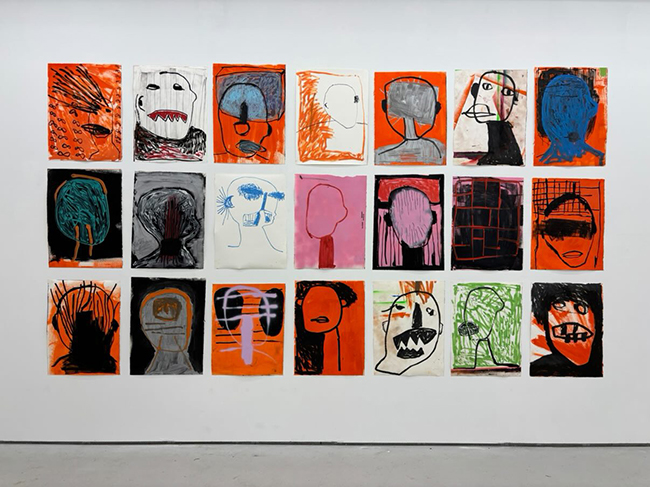
The installation shown here—drawings from White Noise (2025)—captures that circular intensity. The grid of distorted heads functions like a chorus of internal voices. Each piece mirrors another, argues with another, or breaks away from the logic of the group entirely. Bright, acidic backgrounds clash with heavy black lines. Some figures appear stripped bare. Others feel bound or fractured, caught in a kind of psychological pressure. Together, they create a rhythm of interruption and release, as if the whole collection inhales and exhales in uneven breaths.
Wittmer often works on metal or industrial surfaces, choosing materials that resist her or push back. Even when she draws on paper, the energy of those harsher surfaces lingers. You can see it in the scraped marks, the abrupt cuts through color, the unfinished lines that stop because the hand changed direction mid-gesture. Her imagery feels live—electric, messy, unpredictable. She describes it as a “direct, raw visual language,” one that continues to evolve without losing its core intensity.
Her figures are not portraits. They are condensations of psychological states. A head may twist into an impossible shape or collapse into a thick mass of line. Features may appear only to dissolve into abstraction. The work aims for honesty rather than accuracy. It embraces the truth that inner life rarely arranges itself neatly. Wittmer shows the moment when something internal pushes too hard and spills out into the visible world. She captures that tipping point when identity feels unstable and emotion becomes landscape.
What makes her approach compelling is her refusal to smooth anything over. The drawings stay rough, unpolished, almost volatile. This spartan immediacy gives the viewer room to sense their own internal noise. The figures may belong to Wittmer, but they resonate far beyond her. They tap into something universal: the confusion of being human, the intensity of feeling too much, the strange comfort of recognizing your own chaos in someone else’s marks.
White Noise continues her ongoing interest in repetition and fragmentation. The series behaves like a map of emotional frequencies—each drawing a different signal interfering with the next. Some faces appear hollowed, others split, others bold and oversized. Together, they form an installation that reads like a psychological soundscape. It feels noisy even in silence. You sense the hum beneath the surface, the kind of inner static people carry but rarely describe.
Across all of Wittmer’s work, the search is clear. She wants a visual language that is immediate and honest, one that bypasses rational control. She lets instinct drive the process. She trusts the hand. And she stays with a feeling long enough for it to reveal its shape, however distorted or uncomfortable that shape may be. Her drawings live at the threshold between inner life and outer form, between the body and the world, between the self that feels and the self that speaks.
In that space, the work breathes—and invites others to breathe with it.


